In North Vancouver, BC CANADA. St. Timothy's Church is a member of the Anglican Network in Canada (ANiC), with the Anglican Church in North America (ACNA). Our charge by our Bishops is to be faithful and fruitful in our communities. St. Timothy's is a nurturing, biblically-based community growing Christ's Kingdom. READ and GROW in Christ!
Spring is finally here, and it is time for a "Spring cleaning", again. I have noted a few Church Library books missing for some time. Could you please check your shelves, closets, under the couch, etc. to see if there are any books that may have been forgotten or misplaced?
There are a couple children's books missing --- notably, "Joseph and His Amazing Coat" and "Daniel and the Lion's Den" (both are Usborne paperback books). Another is the Christian Classic pocket book fiction, part of a series missing for quite a while --"The Curate's Awakening", by George S. McDonald -- the first book of two in the series (book two is "The Lady's Confession" which is still in the library). Thank you.
Happy Easter, and happy reading for the Soul. Nothing beats reading a Christian book! Please check out our books for all ages any Sunday!
-submitted by M C
Update: "Daniel" has been found... "Joseph" and the "Curate" are still lost...)
Most of us watch films to be entertained. We enjoy seeing a film with a good sense of humor, a film with a satisfying love story, a film with a happy ending, an inspirational story. Less often, perhaps, we watch a film for educational purposes. I am not referring to the documentary films from the National Film Board that I remember as a child (although I do admit to remembering a real sense of excitement when the teacher rolled in the 16mm film projector!), but rather films, which allow us to explore different perspectives on life and situations that we encounter during a normal day.
Jeffrey Overstreet, a Christian film critic who lives in Seattle, best known for his work with the magazine “Christianity Today”, writes film reviews, which encourage me to watch films with a Christian perspective. His opinions on film challenge and encourage me to ask questions and learn more about what it means to be a Christian.
Overstreet believes that Christian film reviews in the past have focused on the dangers of movie going. For example, it might have been suggested to avoid a film because it was “too worldly, might lure people into temptation and could be a stumbling block to the Christian faith”. Jeffrey believes that focusing on the dangers of a film can prevent us from realizing that a good film is like telling a story; it can allow us to encounter a different perspective and enter into someone else's world. Unfortunately, some films do “celebrate” the darkness and make it look very appealing. Think of horror films that exploit “ugly” things just to sell tickets; this is not excellence in film. A good film is real and should enable us to engage with, listen to, and understand our neighbours.
An example of a film, which may be difficult to watch, is “Juno”. A film about teenage pregnancy, it accurately portrays the painful challenges of the situation. Overstreet believes that the film shows how the characters think the challenges through, how they make choices that are “sometimes admirable and sometimes dismaying.” “Some wise decisions lead to trouble, some of the foolish decisions lead to blessings. In that way, Juno resembles real life.”
As much as we all like happy endings, try considering that a good film might not have a happy ending. Life doesn't always turn out the way we want. Our prayers aren't always answered. Christians don't always win. In fact if we are to believe in Scripture, we should believe that Christians are more likely to suffer more than others. A good film will explore what happens when the character doesn't get what he wants. It will explore the good and the bad choices that people make and the resulting consequences.
A good example of this is the film, “Into the Wild”, based on the true story of Chris McCandless a young man who leaves his home and family and essentially abandons life to live as a recluse in the wilderness of Alaska. Throughout the story God reaches out to him through many different people, only for Chris to refuse to “open” the door. In the end, he realizes too late, the missed “golden” opportunities. The film is true to life in so many ways.
In the Gospel of Matthew, chapter 5, verse14, Jesus tells us we are “the light of the world”. The world that Jesus is referring to, is a world with people with real problems; a world with the worst human behaviour, the greatest depravity; a world with people who are truly lost. This is the world where God's love and grace needs to shine brightly. This is what Jesus calls us to be and do. A good film will accurately portray this “broken” world and allow us to enter it and consider what we as Christians might or might not do.
Ultimately film choices are of course a very personal matter. What “works” for one person, may have no effect on another at all. Choose your films wisely, analyze the film for accuracy in relation to life and try and avoid always wanting the happy ending. Overstreet reminds us to “look for moments where you can see the glory of God at work in people's lives and in creation. Watch the film through the lens of faith and allow your faith to be strengthened by the awe-inspiring beauty and power of what God has made.”
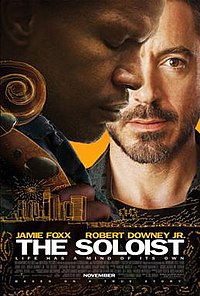
The Soloist:In this fact-based drama, Robert Downey plays Los Angeles Times journalist Steve Lopez. Estranged from his former wife, Mary (Catherine Keener) -- who is still his editor -- Lopez leads a solitary existence in his upscale but empty home, lulling himself into oblivion, night by night, with a bottle of wine and Neil Diamond tunes. With readership shrinking and layoffs all around him, Lopez desperately needs a human interest story to keep his career on track. He stumbles across an especially compelling one when he meets Nathaniel Ayers (Jamie Foxx), a musically gifted homeless man.
As he profiles and eventually befriends Ayers -- whose passion for Bach and Beethoven Lopez finds infectious -- the columnist works to get him settled in an apartment and find him a safe environment in which to practice. Eventually he strikes on the real-life Lamp Community, a refuge on LA's skid row. Like Ayers, whose schizophrenia cut short his promising cello studies at New York's JuilliardSchool, many of the Lamp Community's beneficiaries are on the street as a result of mental illness.
The film examines the topics of mental illness and homelessness and it goes about that task with documentary-like realism, coupled with extraordinary tenderness. The result is a film that packs an emotional wallop and yet, paradoxically, feels hopeful. Hopeful that the simple act of friendship can make a difference in someone's life, even if we are unable to offer solutions for a friend's problems. Lopez desperately wanted to fix Ayers, to help him unleash his musical gift to the full. But it turns out that that's not really the point. Loyalty, faithfulness and determination to keep trying, no matter what—those are the values that matter most, according to this film.
The Visitor:A deeply moving drama built around longtime character actor Richard Jenkins. The Visitor is a simmering drama about a college professor and recent widower, Walter Vale who discovers a pair of illegal aliens who were the victims of a real-estate scam living in his New York apartment. After the mix-up is resolved, Vale invites the couple--a young, Syrian musician named Tarekand his Senegalese girlfriend to stay with him. An unlikely friendship develops between the retiring, quiet Vale and the vibrant Tarek, and the former begins to loosen up and respond to Tarek's drumming lessons as if something in him waiting to be liberated has finally been unleashed. All goes well until Tarek is hauled in by immigration authorities and threatened with deportation. His mother, Mouna turns up and stays with Vale, sparking a renewed if subdued interest in courtship. However, the wheels of injustice in immigration crush all manner of hopes in post-9/11 America. Vale soon realizes that he has unexpected anger over Tarek's plight, and the positive changes to his personal life that emerged from a deep involvement with his friend and Mouna might be the only legacy he takes from this experience. This film explores issues about immigration, culture and music.
Stranger Than Fiction: Harold Crick (Will Ferrell) is an IRS agent whose life is little more than a string of dull, dreary, methodical routines. Every morning he brushes his teeth a certain number of times, and he walks a certain number of steps across the street to catch his bus—and the film annotates his activities with pop-up diagrams that track his every move. Harold's activities are described to us by a female voice-over narrator—and then, one morning, Harold hears the voice for himself. At first this is merely annoying, and it drives Harold nuts—but then the woman's voice makes a cryptic reference to Harold's imminent death, and Harold begins to fear for his life.
The voice belongs to Kay Eiffel (Emma Thompson), a novelist who has a bad case of writer's block; the problem is so bad, in fact, that the publisher has sent her an assistant named Penny Escher (Queen Latifah) to goad her into finishing her latest book. We learn that Kay has a reputation for killing off her main characters, and the reason her current novel is stuck in limbo is because she can't figure out how to bump off the main character—who just happens to be Harold Crick.
Harold turns to a literary prof named Jules Hilbert (Dustin Hoffman), who creates a test to narrow down the possible range of genres to which Harold's life story might belong. Harold also happens to be auditing—and falling in love with—an idealistic baker named Ana Pascal (Maggie Gyllenhaal), so he takes notes every time they meet, tallying the moments between them that seem to point towards a happy ending and those which seem to point towards something more tragic. Of course, since he works for the IRS, and she withheld a portion of her taxes to protest government policies, the relationship might seem doomed; then again, romantic comedies often start with couples hating each other's guts, so who knows?
This very unique but heartwarming film explores topics such as control and meaning in our lives, outside influences and death.
"Silent night, Holy night. All is calm, all is bright. . . ."
The carols try to tell us that this is a calm and silent time of year. But for most of us, the weeks leading up to Christmas can be anything but calm. You know the drill: Christmas parties, shopping, wrapping, relatives, Christmas plays, etc., etc. It's enough to leave even the strongest among us exhausted.
Can we slow things down a little so we can enjoy the season again? Can we put Christ ahead of Christmas?
There is a way to put a little relaxation back into your Christmas season without adding too much to your busy schedule. As we enter the Advent season and get closer and closer to the 25th, try reading a Christmas book, borrowed from the Church Library. Find a quiet corner, a cup of cocoa, and favorite blanket and curl up and read from a selection of:
"The Glory of Christmas: Inspirational Writings from..." - C. Swindoll, M. Lucado, C. Colson "The Purpose of Christmas" - Rick Warren "Christmas in Mitford: Esther's Gift; The Mitford Snowmen" - Jan Karon "The Good Shepherd" - Gunnar Gunnarsson "Christmas Stories..." - Teresa Worman
plus a few more...
There is always available that timeless original Christmas story from the Bible: Luke 2:1-20.
The Church Library is always looking for more reading treasures to add to it's Advent and Christmas collection. Have a Blessed Christmas, everyone.
During the mid-17th century theologians gathered and compiled a document that was meant to encompass the core doctrines and beliefs of the Christian faith. This document, called the “Westminster Catechism”, was one of the most important and influential documents to come out of the Reformation. One of the Catechism's most powerful statements is this - "The chief end of man is to glorify God and to enjoy Him forever."
“In Him we have obtained an inheritance having been predestinedaccording to the purpose of Him who works all things according to the counsel of His will, so that we who were the first to hope in Christ mightbeto the praise of His glory.”(Ephesians 1:11-12)
Our church library is full of books written by worshipful authors who glorify God and enjoy Him, through their writings, so that we may also better understand the passion of glorifying and enjoying God, the Son, and the Holy Spirit. We have many books about prayer, and devotionals that help guide us in glorification of our God, for both young and old.
Inspirational books (both fact and fictional) tell stories of people who were lost, and then found by God, and how their lives were changed by glorification and enjoyment in the service of God. None of these books ever replaces the utmost authority of the Bible, but help to broaden our faith and understanding of the Word.
As the crispy autumn days comes upon us, let us grow and harvest the books of St. Timothy’s Church
library, broadening the horizons of our faith:
“And one of the scribes came up and heard them disputing with one another, and seeing that He answered them well, asked Him, ‘Which commandment is the most important of all?’ Jesus answered, ‘The most important is, Hear, O Israel: The Lord our God, the Lord is one. And you shall love the Lord your God with all your heart and with all your soul and with all your mind and with all your strength.” (Mark 12:28-30)
Summer holidays are just around the corner, and what a great time to pick up a book or two from your Church Library for reading during those balmy evenings ahead.
I encourage the church children and youth to check out some of the books, now that school is almost over --- more time to read and grow as a Christian over the holiday months. During the next few months the Church Library will become "reorganized", with new selections from the many donated and new books that have been received --- and have yet to be catalogued. The Church Librarian has got a busy summer ahead of her... (smile)
I also am calling an "amnesty" on any books borrowed in the past, that have not yet been returned to the Church Library. If you have any of those books lying around the house, or on your bookshelves, please bring them back for others to enjoy. Have a great summer reading some great Christian books. Check out your Church Library, today.
Sitting through a movie about sibling rivalry at a wedding, especially one starring the doe-eyed and normally facile Anne Hathaway, sounds like a potentially painful way to spend an evening. However, as directed by Jonathan Demme and written by Jenny Lumet (Sidney's daughter), this 2008 drama is not a lightweight star vehicle à la Julia Roberts circa 1997 but a darkly realistic look at the dysfunction within a family thrown into disarray. Using an almost cinéma vérité style, Demme explores how a wedding reopens old wounds within a family in a naturalistic way made all the more palpable by the emotional acuity in Lumet's screenplay. This film beautifully explores issues of redemption and forgiveness. This film is rated R for language and sexuality.
Millions
From legendary director Danny Boyle comes “a family film of limitless imagination and surprising joy!” It’s holiday season and seven-year-old Damian believes he’s received a divine gift from above when a suitcase filled with cash literally falls out of the sky. Damian is anxious to share the wealth with those less fortunate while his fun-loving brother Anthony would rather spend it like there’s no tomorrow! But when the loot turns out to be stolen, both the boys’ plans are put to the test—with heart-warming and hilarious results. This film could provoke and interesting discussion on the Christian’s role with charity and giving to the poor.
Slumdog Millionaire
Winner of 8 academy awards, including best film, this film is directed by Danny Boyle (Millions). A Mumbai teenager, who grew up in the slums, becomes a contestant on the Indian version of "Who Wants To Be A Millionaire?" He is arrested under suspicion of cheating, and while being interrogated, events from his life history are shown which explain why he knows the answers. This film explores issues about poverty, choices, survival and love.
Savages
Starring award winning actors Laura Linney and Philip Seymour Hoffman, this film is about Jon and Wendy Savage who are two siblings who have spent their adult years trying to recover from the abuse of their abusive father, Lenny Savage. Suddenly, a call comes in that his girlfriend has died, he cannot care for himself with his dementia and her family is dumping him on his children. Despite the fact Jon and Wendy have not spoken to Lenny for twenty years and he is even more loathsome than ever, the Savage siblings feel obliged to take care of him. Now together, brother and sister must come to terms with the new and painful responsibilities with their father now affecting their lives even as they struggle with their own personal demons Lenny helped create. This film explores issues related to caring for aging family members, facing life’s trials, and coping with death. This film is rated R for language and sexuality.